Japanese Health Insurance
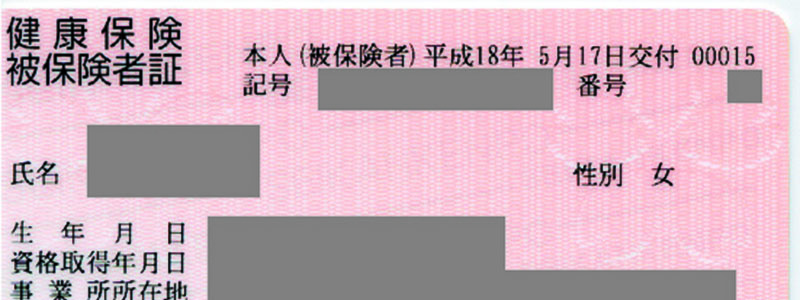
 There are two main kinds of public health insurance in Japan – Social/Employee’s Health Insurance and National Health Insurance. Social/Employees' Health Insurance is provided to most full-time employees through their work. National Health Insurance is provided through municipal offices. By law, all residents of Japan (including foreign nationals with a residence card) must be enrolled in a public health insurance program. Those over the age of 40 are also required to pay Long-term Care Insurance.
Note that as of December 2, 2024, traditional health insurance cards are no longer issued. The My Number Card now serves as proof of insurance at medical facilities. Those without a My Number Card can request a free Eligibility Confirmation Certificate from their municipal office. From June 2027, failure to pay National Health Insurance premiums may affect visa renewal eligibility.
Social/Employees’ Health Insurance Shakai Kenko Hoken (社会健康保険, Social/Employees' Health Insurance) is a workplace-based health insurance system for company employees and their dependents. Premiums are based on your income (around 10% in total, with each party paying approximately 5%), and will be shouldered equally by the employer and employee. The employee’s portion is automatically deducted from their salary each month. The number of dependents an insured person has does not affect their premiums. However, if a dependent’s annual income exceeds ¥1,300,000 they will be required to get their own insurance.
Since October 2024, part-time workers at companies with 51 or more employees who work 20 or more hours per week and earn ¥88,000 or more per month are also required to enroll in Shakai Hoken.
National Health Insurance Kokumin Kenko Hoken (国民健康保険, National Health Insurance) is run by local municipal offices and designed for self-employed persons, students, and others who do not have Employees’ Health Insurance. Foreigners who will be resident in Japan for more than three months and are not covered by Employees’ Health Insurance must register for National Health Insurance. The municipal office will often ask if you wish to apply for health insurance when you register your address. Monthly contributions will differ based on where you live, your income, and number of dependents. You can check details at your local municipal office.
Residents from countries with a social security agreement with Japan may be exempt from enrollment. Check with your municipal office for details. From June 2027, unpaid NHI premiums may affect your eligibility to renew or change your visa. Also note that as of December 2, 2024, traditional health insurance cards are no longer issued. The My Number Card now serves as proof of insurance at medical facilities.
Paying for treatment
In Japan, medical expenses must be paid on completion of treatment. Japanese Health Insurance generally covers 70% of the cost of diagnostic and treatment procedures for those aged 6 to 69. Those aged 70 to 74 pay a 20% copay, and those aged 75 and over pay 10%, though higher-income earners in these age groups may pay up to 30%. And is accepted at most clinics and hospitals. The remaining 30% can be paid in cash. Patients without Japanese insurance should confirm their payment method before treatment, and pay by cash or credit card (if accepted) on completion of treatment. For treatments that fall inside the bounds of public health insurance, the cost of treatment should not differ, regardless of which clinic you go to. A consultation fee will always be charged when you see a doctor, even if no treatment was undergone. The fee varies depending on the type and size of the medical facility. Note that visiting a large hospital without a referral letter may incur an additional surcharge.
Some services such as health check-ups, Ningen-dock (人間ドック, comprehensive medical examinations), dental check-ups and special operations such as implants may not be covered by insurance, so it is always advisable to inquire first.
If your medical expenses exceed a certain amount in a given month, (known as kōgaku ryōyōhi (高額療養費, high-cost medical expenses) the amount above the limit will be reimbursed to you. For standard income earners, the monthly cap is approximately ¥80,100. If you anticipate high medical costs, you can apply in advance for a “Ceiling-Amount Application Certificate” from your insurer, which limits your out-of-pocket payment at the counter directly. Reimbursement may require a separate application depending on your insurer.
Private and Foreign Insurance
Private insurance plans are available that will reimburse the portion of fees not covered by public insurance. If you do not have Japanese Health Insurance or the facility does not accept it, your medical expenses must be paid in full on completion of treatment. Some clinics specifically serving foreign residents may not accept Japanese public insurance, so it is advisable to confirm in advance. Foreign and International insurance schemes may allow you to receive reimbursement for medical expenses incurred in Japan. You should check with your provider to see which services are covered. The medical facility will be able to provide you with the necessary forms needed to claim expenses from your insurance company.
Private insurance is a supplement to, not a replacement for, public health insurance. Enrollment in public health insurance remains mandatory for all residents staying three months or more.


